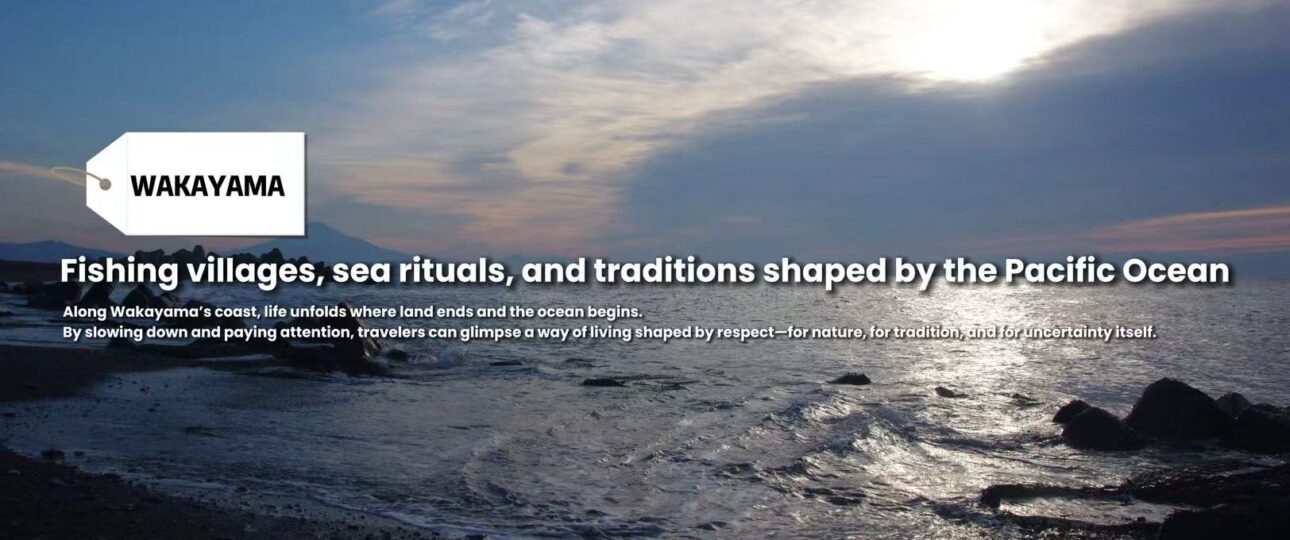
In Wakayama, the mountains do not end where the sea begins. They descend sharply, forests giving way to cliffs, roads winding until they meet the Pacific Ocean. This geography has shaped not only livelihoods, but belief systems and daily rhythms along the coast.
For centuries, coastal communities in Wakayama have lived with an acute awareness of nature’s power. The sea provides sustenance, but it also demands respect. Out of this relationship grew rituals, customs, and a way of life that continues quietly today.
Life Built Along a Narrow Edge
Wakayama’s coastline leaves little room for expansion. Villages sit tightly between steep hills and the water, shaped by necessity rather than planning.
Homes face the sea. Harbors double as communal spaces. Daily schedules follow tides and weather rather than clocks. In these towns, the ocean is not scenery—it is a constant presence that dictates movement, work, and rest.
Travelers passing through quickly may miss this dynamic, but lingering reveals how deeply life here is structured by the shoreline.
The Sea as Provider and Judge
Fishing has long sustained Wakayama’s coastal communities. Yet unlike industrial ports, many villages rely on small-scale, seasonal practices passed down through families.
This dependence fosters humility. Before heading out, fishermen still pause at small shrines or offer brief prayers—not as formal ceremony, but as habit. These gestures acknowledge uncertainty, reinforcing a worldview that accepts risk as part of living with nature.
Such beliefs are not nostalgic remnants. They remain relevant because the sea remains unpredictable.

Maritime Rituals Without Spectacle
Unlike well-known festivals designed for visitors, Wakayama’s coastal rituals are understated. Events marking safe voyages, abundant catches, or seasonal transitions often occur without announcement.
Locals gather briefly, complete the ritual, and return to daily tasks. There is little explanation, no effort to interpret meaning for outsiders.
For travelers, encountering these moments unexpectedly can be deeply moving—precisely because they are not performed.
Food as Cultural Expression
Coastal Wakayama’s cuisine reflects restraint and clarity.
Meals emphasize freshness and simplicity: grilled fish, lightly seasoned vegetables, rice prepared without excess. Flavor is not layered for effect, but balanced to highlight ingredients at their peak.
Eating in these villages offers insight into values shaped by environment—efficiency, respect for resources, and appreciation for what the sea offers that day.

Planning a trip to Japan and not sure where to start? We’re happy to help you design a journey that fits your travel style.
Shrines Facing the Horizon
Many coastal shrines in Wakayama are positioned with direct views of the ocean. Their placement reflects a belief that the boundary between human life and the divine lies at the water’s edge.
These shrines are rarely grand. Weathered by salt air and wind, they blend into the landscape. Offerings are simple. Maintenance is communal.
Standing at these sites, travelers sense a form of spirituality rooted not in transcendence, but in coexistence.
The Rhythm of Coastal Time
Time moves differently along Wakayama’s coast.
Early mornings begin before sunrise. Afternoons slow once boats return. Evenings are quiet, shaped by preparation for the next day rather than entertainment.
This rhythm can feel unfamiliar to visitors accustomed to constant stimulation. Yet it offers a rare opportunity to observe life unfolding without interruption.
Traveling the Coast with Awareness
Wakayama’s coastal areas are not built for rapid tourism. Public transport is limited, distances are deceptive, and amenities are modest.
Thoughtful planning allows travelers to engage without imposing. Choosing fewer locations, staying longer, and moving with flexibility aligns more naturally with local life.
Such an approach transforms the coast from a backdrop into a lived experience.
Between Land and Water
Wakayama’s coastal culture exists in balance—between mountain and sea, certainty and risk, work and belief.
It is not dramatic, nor easily summarized. Its meaning emerges gradually, through observation and presence rather than explanation.
For travelers seeking a deeper understanding of Japan’s relationship with nature, Wakayama’s coastline offers one of the country’s most quietly profound landscapes.

From itinerary planning to local recommendations, our consultation service helps you travel Japan with ease and confidence.
Listening to the edge of the land
Along Wakayama’s coast, life unfolds where land ends and the ocean begins. By slowing down and paying attention, travelers can glimpse a way of living shaped by respect—for nature, for tradition, and for uncertainty itself.

Create Your Own Travel Booking With Us
We specialize in crafting unforgettable journeys across Japan. Whether you’re a solo traveler, couple, or family, our expert planners, multilingual guides, and customer care team ensure your adventure is seamless and unique — from first click to final destination.
Create your travel booking website with us — and let your story unfold in Japan.